

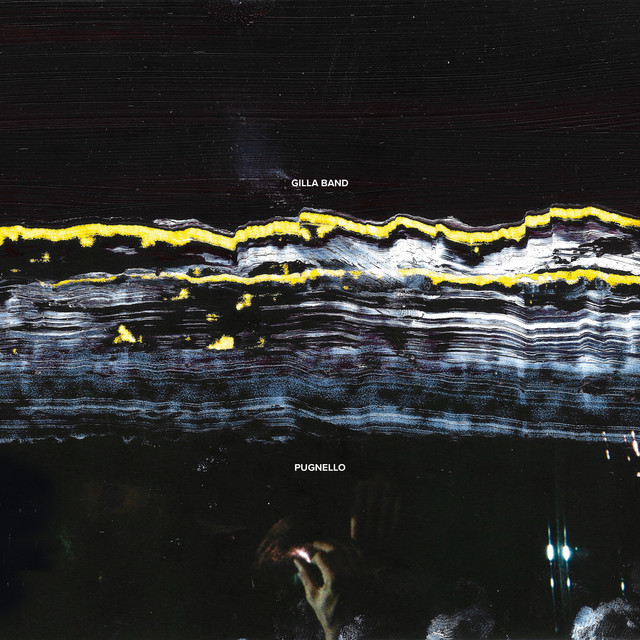
Gilla Band | Pugnello [Rough Trade Records]
Noise Rock / Industrial Techno / Post-Punk | 2026
Gilla Band's fourth album begins at full volume and then finds several ways to make that volume unsettling. Across ten tracks, the Dublin quartet push distorted guitars into rigid electronic patterns, force rapid drums against slow bass figures and give Dara Kiely's increasingly exposed words very little room to settle. The arrangements are exacting. Each abrupt change of tempo or texture alters how the previous passage feels. On Pugnello, rhythmic control makes the band's most abrasive material unexpectedly physical.
"The Angelus" gets there immediately. Adam Faulkner's accelerated drumming keeps shifting the accents while Alan Duggan Borges sustains heavily distorted guitar tones. Kiely shouts disconnected Irish phrases, television references and idioms with near-breathless urgency. The overlapping parts remain sharply timed even at their most saturated. That precision matters across a record produced by the band and recorded and mixed by bassist Daniel Fox, whose low frequencies are frequently the clearest component of the mix.
"Placeholder" gives Fox a particularly memorable part: a heavily distorted bass figure that anchors the opening assault. Midway through, the arrangement changes to a spare dance pulse with clipped guitar and elastic bass movement. Kiely moves from childhood television memories and Power Rangers to a painfully direct admission about his father's absence. His reference to blasting Coldplay is funny because the delivery is so aggravated. The track's changing rhythm lets the humor and grief coexist without smoothing either away.
"Alogia" concentrates that tension. A thick, repetitive bass groove and blunt electronic tones give Kiely a stable rhythmic pattern while he addresses his schizophrenia diagnosis explicitly. The title refers to diminished speech, yet the vocal is insistent and crowded with words. His comic phrasing complicates the seriousness without diminishing it. The repetition is effective because the instrumental parts keep changing their emphasis underneath the voice. There is genuine pleasure in the groove, even when the timbres become harsh.
The middle sequence asks for patience. "Three Hands Clapping" is short and densely layered, ending with multiple Kiely vocal parts colliding. "Jacobsons" sustains a punishing electronic rhythm while he struggles with the expected response to bereavement. Its vocal intensity can be difficult to take in one sitting, although that difficulty follows directly from the subject. On "The Megazord", an unstable synthesizer figure repeats against heavy percussion and bursts of guitar noise. These tracks do not offer conventional melodic release. Their development comes through changes in timbre, repetition and the placement of the voice.
"Computer Sadness" briefly shifts the focus toward distorted vocal melody, with more open space around the electronic percussion. "Giraffe" then makes one of the album's most effective structural turns. A distorted bass line and jagged vocal fragments eventually give way to a driving techno rhythm, with Faulkner's change in emphasis transforming the track's momentum. Kiely's final memory of his mother insisting he wear a suitable jacket introduces a specific kind of care. The lyric is affectionate and unsure at once, which makes its placement after so much agitation especially affecting.
At nearly eight minutes, "Crisp Pop" gives the group its longest stretch of rhythmic experimentation. Interlocking percussive figures, abrasive distortion and pitch-altered vocals build a dense pattern that becomes increasingly difficult to follow. Kiely's lyrics assign potato-chip flavors to Oasis, Blur and Pulp, an absurd joke delivered with little concern for intelligibility. The extended duration tests the album's stamina, and some of the middle repetitions feel overworked. Still, the band earns the length through the precision of the shifting rhythms.
The closing "At the Gallop" changes the emotional register again. Named after an album by Cromwell, the band of Kiely's late father, it uses processed vocals to present an imagined exchange between them. The electronic treatment creates emotional distance in words concerned with loss, resentment and the desire for contact. That unresolved ending is the album's strongest decision. Pugnello can be exhausting, and its constant intensity occasionally limits the impact of individual passages. But its finest moments join exacting composition to unusually candid writing. The group's electronic experiments have become inseparable from its songwriting, while Kiely's humor gives the most personal material room to remain complicated.
Rating: [4.5/5]